A question I get quite often is about the hatchets I use in preparing stock for joined furniture. There’s a new article in the Oct 2011 Popular Woodworking Magazine, “The Best Oak Money Can’t Buy” in which I outline some of the steps in splitting and riving oak boards. In most cases, after splitting the stock out, there is some hewing done with a hatchet.

I’ll show some shots of the 2 principal hatchets I use, and discuss why they are good ones. Then I’ll tell you I don’t know where to get them. These are hewing hatchets, joiners’ hatchets, side hatchets…they have lots of names. Broad hatchet might be another one. Main feature is a single bevel, I’m right-handed, the single bevel is on my right when I use the hatchet.
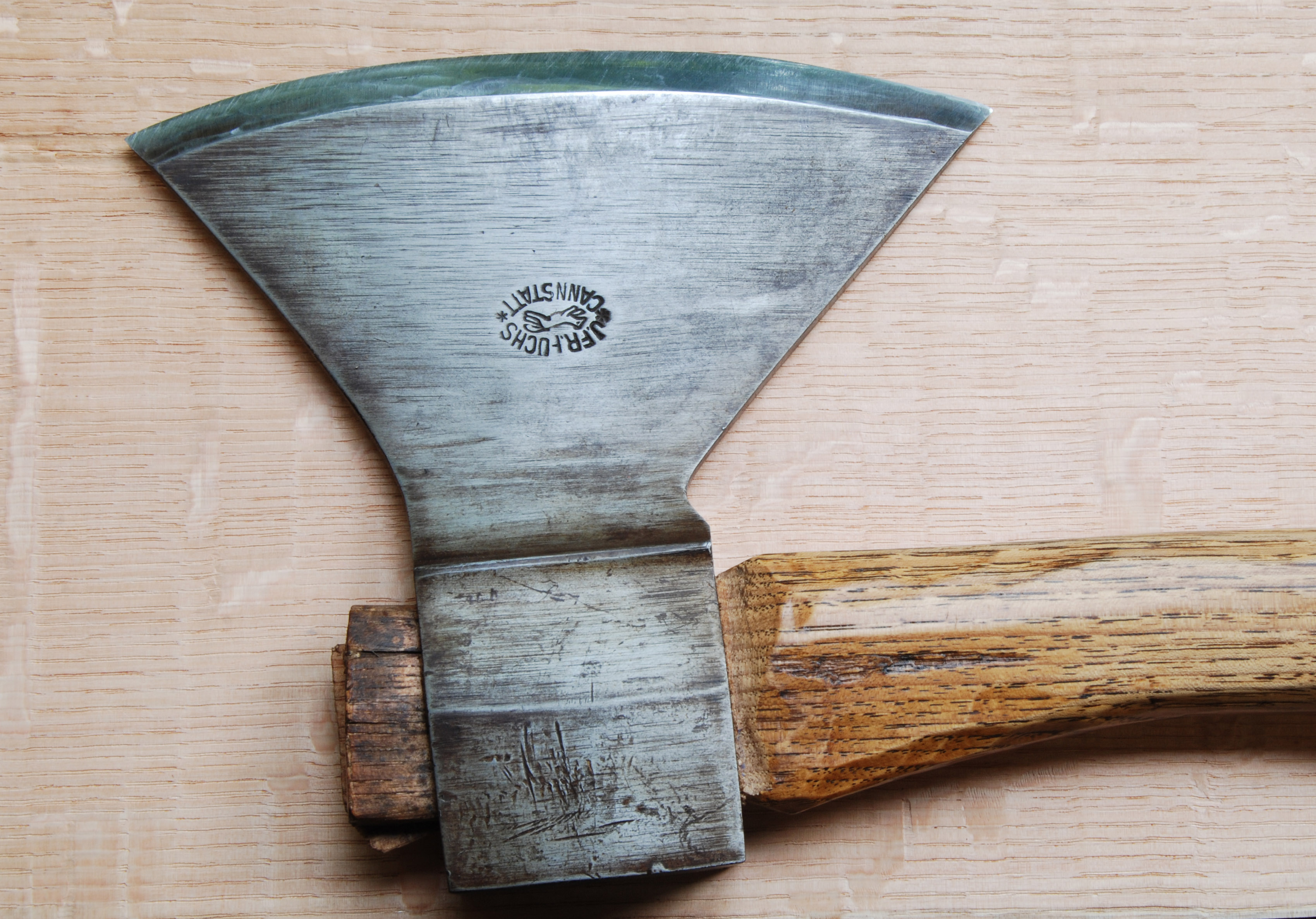
This one is my everyday hewing hatchet, made in Germany before 1933. A couple years back I wrote about it on the bodgers forum http://www.bodgers.org.uk/bb/phpBB2/viewtopic.php?f=2&t=424&hilit=Fuchs&start=15#p4074 and got a note that outlined part of the firm’s history, citing a move from Cannstatt to Stuttgart in 1933. The hatchet weighs 3 lbs 7 oz. and is about 7 ¾” along its cutting edge. The edge is curved, and the back of the hatchet is slightly dished; to help in stock removal. This dishing of the back is usually only seen when you put a straightedge along the back of the cutting edge. The handle of this hatchet is in line with the eye. Here’s the view showing the shape of the head:

Here’s another from the same makers; this one has an eye that is canted from the plane of the hatchet’s flat face. This gets your handle moved outward, in essence keeping your knuckles from getting skinned. If you have a hatchet whose eye is in line with the head, you can always make a steam-bent handle to achieve the same idea. This one is 3 lbs 4 oz; a tiny bit lighter than the previous one. Cutting edge is 7” long.

this next view shows the angle of the handle to the head.

here’s one more, that I don’t have the specs for, it’s Jennie’s long-time favorite. Same firm, same story – pre-1933 Germany.

So all of these are oldies; but not too long ago there were excellent German hatchets still being sold in the US. Alexander bought this one at Woodcraft back in the late 1970s, early 80s. I had one too, but gave mine to an apprentice c. 1990. I haven’t been able to find out who made this one, it’s marked FWB with a stag on it. It weighs 2 lbs, 8 oz and its cutting edge is about 5 ¼” – it’s an excellent hatchet.

here’s the profile view of this one:

There – now you know what Alexander & I think is a good hatchet. Later, I will show you some that JA has modified from double-bevel axes to effectively come up with a hewing hatchet that works.
 PETER FOLLANSBEE: JOINER’S NOTES
thanks Peter.
Hope Irene does not make too much extra work for you.
Colin
Oh man…thats the best time to get FREE felled trees.
I drive around after a storm looking for felled trees. Check craigslist for folks posting free cut up trees…you might score some nice stuff.
Peter, following your advice I went to ebay deutschland and looked for and found a hatchet I am quite pleased with. Nervous making but worth it.
Richard: when you have a chance, how’s about a picture?
Yeah, German ebay is absolutely fantastic. I have bought numerous period tools there. Last month I won a 16th/17th century long plane. Few weeks ago I won two mid 18th century fore planes; they arrived today actually. Most stuff after 1600 is still pretty new to most Europeans. And because of the Cold War, a lot of places in Eastern Germany, Eastern Europe and Russia produced tools that were unchanged from late medieval versions. Many of those tools were also hand forged. Or if cast, they were still unchanged in large measure.
But fellas, check out this guy… I have several of his axes. They are mostly 19th century and most still have good edges.
http://www.ebay.com/sch/helloantik/m.html?_nkw&_armrs=1&_from&_ipg&_trksid=p3686
Peter, your unidentified axe with FWB and a stag symbol was made by Busch Bros., of Remscheid, Germany.
http://www.holzwerken.de/museum/hersteller/hirsch.phtml
Please let me know if you’d like a translation of the entry for the company; it would be a very small repayment for all the pleasure I’ve had from your blog.
Best wishes
Ken Baddley
Bedford
England
Ken: glad you like the blog…and thanks for the ID on the hatchet. I’ll sift through there, & see if we need some text. Really the main thing is – do they still make this hatchet somewhere?
Hi everyone – Im not sure if it is of interest but I have found some more information in regards to the FWB brand. I recently scored a IL&S (Lingenberg, J. & Sohn) ‘Roland’ 12 (30cm edge) hewing axe head – the only reason I spotted it was because I had seen the Fuchs hewing hatchet (3lbs 4oz) with the cranked eye that Peter recommended. Once in my hands, it was clear it shared very similar characteristics to the Fuchs and FWB hatchets shared on this post. After some research I was pleasantly surprised to see that the IL&S company were affiliated with, or even produced the FWB tools. Im still trying to figure this out though!
see here for info on IL&S and FWB trademarks: https://altebeitel.de/index.php/d/16-hersteller-haendler/deutsche-hersteller-haendler/177-lingenberg-j-sohn
and you can see the mention of the Jacob Lingenberg company (IL&S) in the original holzwerken link that Ken posted above.
If anyone is interested to see the IL&S hewing axe head that I have acquired just let me know in a reply on here – It has a canted eye, slightly curved edge and a small dish or hump in the ‘flat’ side of the edge to aid in the blade not getting stuck in the cut. It is set up for a right hander and has a 12 inch edge, weighing about 5 pounds. I need to handle it and Im excited to use it!
Best wishes to everyone from Portugal + thank you Peter for your excellent posts and information as usual!
Angus
Peter,
Thank you for the close-ups and the description. I have seen you wielding the hatchet many times in pictures/shows but never knew that it
a. had a bevel only on one side like a hewing hatchet, and
b. a handle that wasn’t in line with the cutting edge – similar to the ‘medieval’ goose wing hatchets.
I was lucky to find the head of an Underhill hewing hatchet with about 2 inches of laminated steel on the blade – local antique shop: $8. That hatchet holds and edge beautifully and still is easy to sharpen when needed.
I have considered changing the handle to an offset handle but I don’t have good experiences with the balance of such hatchets.
It seems that your hatchet with a straight handle but an angled poll would be much more balanced and effective (?)
I was just about to suggest that no one makes those hatchets anymore when I doubted myself and searched for some of the Austrian and German axe makers. It seems even the old goose wing hatchet is still being produced:
http://www.traditionalwoodworker.com/Finishing-Broad-Axe-German-Pattern-Biber-Classic-Hand-Forged-in-Austria-by-Mueller/productinfo/367-2051/
Alfred
Alfred – thanks for the legwork on the Mueller axes. that goosewing is nice, but $$$.
their small hatchet seems OK – but with such a wide eye, the handle gets bulky right near the head. So you can’t choke up on this as much as I would like. But it looks like it might be worth trying for someone looking for this sort of tool.
and what I forgot to say is the goosewing is an actual axe, not a hatchet. good for timbers, too big for furniture hewing. I think it said 14″ along the cutting edge. Maybe 6 lbs…
Just to repost in case anyone missed it….see my comment above for more info
http://www.ebay.com/sch/helloantik/m.html?_nkw&_armrs=1&_from&_ipg&_trksid=p3686
Another thought. Contact a blacksmith to forge one for you. I do some blacksmithing, myself but will sometimes oursource to guys who specialize in tools, axes etc.
Peter
Thank you for your blog on hewing hatchets. Wow! What a functional family. One quibble. As you point out, the “flat” side of the hatchet is not perfectly flat. Nor is it, as you say, slightly “dished”. The Oxford English Dictionary defines dished as, “Shaped like a dish; made slightly concave.” To facilitate the easy removal of wood fibers, regardless of their orientation, the blade’s “flat” side is slightly convex. The top and bottom of the blade do not sink into the work piece’s surface. The chip flies away. The fore-plane’s and scrub plane’s convex cutting edges serve the same purpose.
Hewing hatchets can sometimes be found on the Internet. It is helpful if the dealer has a return policy. Understandably, many hewing hatchets have had a hard life.
Jennie
JA
thanks for the distinction. A case of “I knew what I meant…” but didn’t say it right. you nailed it.
PF
My father in law’s father made furniture by hand in the Dominican Republic from the 1930s to 1970s I believe. There were few power tools, so most everything was done by hand. My father in law showed me how to use a regular hatchet (not an offset style) and essentially do what timber framers do by landing heavy blows at regular intervals and then spitting them off via the same axe.
This was how I originally learned hewing before I acquired offset blade axes. I think in many ways the art of using a straight axe/hatched first is important because it teaches rudimentary skills. Then, moving to an offset blade axe is like ‘butta’ but since the basic skill set is already there….its rather like learning surgery with a scalpel and then advancing the game with the increased precision of a robotic laser.
Thank you for this wonderful tour of hatchets. Your last sentence peaked my interest as a possible way to hew for less cash outlay. Would you consider a follow on post showing the modifed double-bevel axes you spoke of ?
online gambling ireland…
[…]the hatchet « Peter Follansbee, joiner's notes[…]…
[…] If you’re reading or working along with many of us who are returning to the roots of the craft and building the Follansbee/Alexander Joint Stool (I talked about it here), there are a few tools that are less commonly found in most of our shops. In most cases, you can get away with using other tools (yes, you could even use your machines). I thought it worth the learning experience of trying to use the tools an early joiner might have (as much as possible). One of these is a hewing hatchet. […]
Highland Woodworking in Atlanta carries both the left-hand and right-hand Ox-Head “broad axe” (hewing hatchets). Haven’t tried them, but they look all right.
Like I said, I haven’t used one, but I did look at one once. It seemed like it needed work.
You can get side axes (r and L bevel) from Gransfor Brueckes, Wetterling and also via some French E Bay sites. Timeless Tools sell 2nd hand ones but mucho diniro. Some smiths do make them like Dave Budd; Dorset Blades. I have several. The smaller ones were made by putting a laminated axe head under a 1 1/2 ton press and I use it for spoon carving. (500 gm blade) The bearded axes with the off set haft are popular with timber framers. Lots used in France. You can get bearded axe; Japanese style , from Axminster Tools. Dik.biz of Germany also sell side axes. Bodger
[…] Lost Art Press published Make a Joint Stool from a Tree, I’ve wanted a cool hatchet like Peter Follansbee uses, his made my J.R. Fuchs in Germany. Well they seem to be impossible to find, but at […]
[…] Lost Art Press published Make a Joint Stool from a Tree, I’ve wanted a cool hatchet like Peter Follansbee uses, his made my J.R. Fuchs in Germany. Well they seem to be impossible to find, but at […]
Hi Peter (and everyone!) — A question I have not really seen a ready answer to is what angle do you sharpen a broad axe (or hatchet) to? Do you still follow the basic axe angles (say, 25 degrees included angle as recommended by “an axe to grind,” regardless of number of bevels)? Or is it thicker or thinner? I’ve just picked up a nice Kent pattern double-bevel (still looking for a good single bevel) here in NH and don’t want to ruin it…
Appreciating the hard work you put into your blog
and detailed ideas you provide. It’s good to come across
a blogging every every now and then that isn’t the same outdated rehashed information. Fantastic read!
I’ve take note your site and I’m including your
site posts to my bookmark account.
Scored one of those FWB models off ebay last week. Never been hafted, came with and offset haft blank. Beautiful thing, not as nice as the old ones, but pretty nonetheless. $50 well spent.
Unfortunately the word botch comes from the word bodger but only is a reflection of an aristocratic mindset author looking at the crude lifestyle of the chair bodger (see books on English Country Crafts) who lives on site splitting, hewing. draw-knifing, and using a reciprocating lathe inside of a teepee-like hut sometimes made of their own wood shavings They worked Beech into chair parts (legs, rungs, etc) for the factories in a coppice–the new wood sprouting from the roots after they move on to the next site–rotating to a new site on a cycle that in theory is sustainable–they will return to the same site every 20-30 years. Tom Conroy called me a book bodger which I took as high complement in that my life goal has been to make a medieval replica book from raw materials. The whole saying—-“Hew to the line and let the chips fall where they may” I used to regularly find hewing hatchets for 5-20 $ but the last few years I rarely see them for sale in 2nd hand stores for any reasonable price– My personal favorite is the 2 lb ones. Many carpenters (before skill saws) wouldown a carpenter’s side axe to make stakes for pounding into the ground and hewing angles on siding to fit eaves which was much faster than sawing diagonal cuts with a hand saw. Crudely hacked diagonal cuts on siding would be covered with trim boards. I’ve taken down a lot of buildings. I’ve been in love with hewing for over 40 years and make thousands of bone tools roughing out elk and deer leg bones after bandsawing with my 2 pounder. Of course it requires frequent sharpening as bones really eats up the edge. Leather workers and binders have always used bone tools. I’ve only hewn a few logs with the classic broad axe, but have many hours on the 2 & 3 lb. hewing hatchet including many split and hewn book covers. Enjoy. Jim Croft–never posted on the stupid computer in his whole life.
I know this is an old post, but it has been my drive for the past few months. Finally, this evening, I pulled the trigger(for a bit more scratch than intended, maybe) on one of the Woodcraft FWB hatchets, complete with Woodcraft(circa 70’s, I assume) handle. If interested, I can send pictures, as soon as it arrives. It does appear to be identical(the head, not haft), and given the branding, I imagine it is. I can’t help but wonder if it would be possible(plausible, legal, rational, etc.) to find a willing Blacksmith to study and replicate this pattern? I know there are ample options, and my modified hatchets have all done just fine(so far; very green to this green business), but I am a big proponent of the destruction of elitism regarding tools for working anything, and if I can contribute to making good tools more accessible to people new to or working on a tight budget toward any hand craft, then I would be happy to do so. Not sure it would be any more affordable, but possibly more accessible. Maybe that makes sense, maybe not. I see an awful lot of hoarding under the guise of “collecting” when it comes to good tools, and to each their own, but more people need to think like our host, Mr. Follansbee, passing tools along when the time comes. Enough rambling. Just thought I would help account for another of the woodcraft hatchets. Done and done.